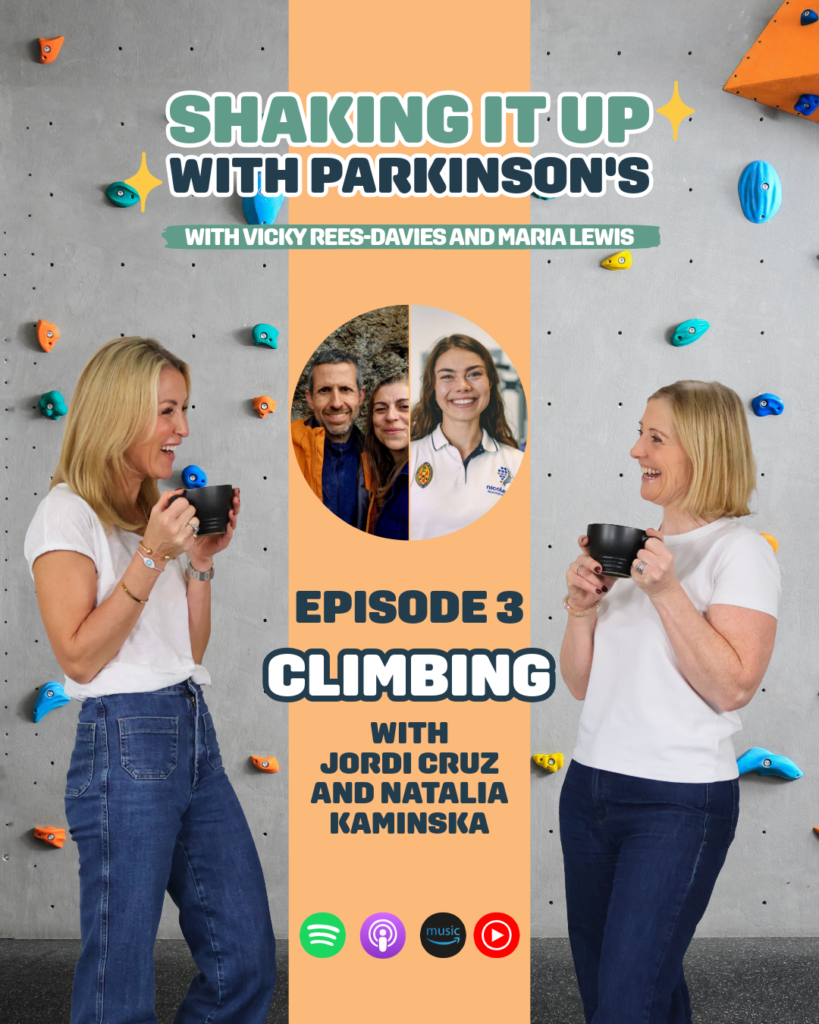
Episode 3 of Shaking It Up With Parkinson’s
In the third episode of Shaking It Up With Parkinson’s, hosts Vicky Rees-Davies and Maria Lewis sat down with two very special guests – Jordi Cruz and Natalia Kaminska.
Jordi Cruz is a physiotherapist and professional climber with young-onset Parkinson’s. After his diagnosis, he began exploring the benefits of the sport for Parkinson’s.
Natalia Kaminska is a neurological physiotherapist who works with people with Parkinson’s. After being looked at like she was ‘crazy’ for suggesting her Parkinson’s group try out climbing, Natalia has found the sport successful for those with this condition, starting up her own Parkinson’s climbing group with the support of Parkinson’s UK.
Together, they made a compelling case for why climbing is an ideal all-in-one exercise for those in the Parkinson’s community who are looking to try something new.

“It’s a Thinking Modality That Makes You Sweat”
Maria has a key phrase: exercise for Parkinson’s is a thinking modality that makes you sweat. Climbing, she says, fits this description perfectly.
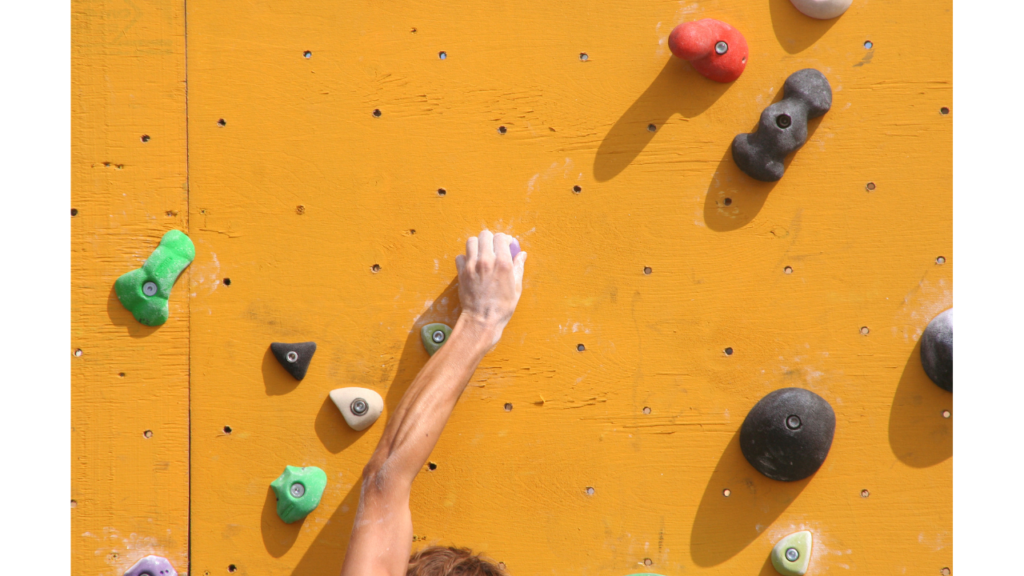
When you’re on the climbing wall, your brain is working as hard as your body. This is why Jordi describes the sport as a puzzle. You’re constantly problem-solving, gripping coloured rocks, planning your next hand hold, and trying out different options whilst balancing on the wall and coordinating your movements.
As Jordi’s wife and translator Rebecca put it, climbing is probably one of the only sports where the concentration required is so total that “you cannot think about anything else.”
This combination of physical and cognitive challenge is called ‘dual-tasking’ – an essential component of any Parkinson’s-specific exercise: you need to work your brain.
Why Climbing Helps…
Natalia breaks down the physical benefits clearly:
- Balance and coordination: constantly shifting weight, finding stable positions, and landing on both feet
- Posture: staying upright and controlled on the wall
- Grip strength: essential for everyday life and often affected by Parkinson’s
- Big, full-body movements: exactly the kind of exercise recommended for Parkinson’s, as the condition causes your movements to shrink
- Leg strength: most people assume climbing is all arms, but leg strength is just as important
Maria added that the recommendations from Parkinson’s research point consistently toward exercise that is cognitively challenging, involves large movements, and works on balance and strength together. “Climbing hits all of those points,” she said.
The Velocity Connection: A Key Discovery
One of the most fascinating parts of the conversation comes from Jordi’s own experience as both a physiotherapist and as a person with Parkinson’s. He’s been exploring what’s known as velocity training, fast movements at low to moderate intensity, as a way to address one of Parkinson’s most universal symptoms: bradykinesia, or slowness of movement.
Maria explains: every single person with Parkinson’s will have bradykinesia, it’s a necessary symptom for a Parkinson’s diagnosis. As symptoms progress, bradykinesia can make it harder to correct yourself in time to prevent a fall.
Jordi noticed that when he trained with fast, explosive movements before climbing, even just in his warm-up, he performed better on the wall. He’s now building his training around velocity, and teaching others to do the same. At an event in the Netherlands, he was able to measure the difference between climbers with Parkinson’s and non-climbers with Parkinson’s. The gap in reaction speed and movement quality was significant.
Training at roughly 40–60% of your maximum load, so around half of the heaviest weight you can lift, but moving as fast as possible helps recruit muscles more quickly, which is exactly what bradykinesia impairs. Natalia noted that this principle doesn’t need to stay on the wall; it can be brought into any exercise regimen.
One important note from Jordi and Rebecca: when your velocity starts to drop, stop. Rest is as much a part of the prescription as the exercise itself!
It’s Not Just Physical — It’s the Community
Natalia described a man with Parkinson’s who came to one of her climbing sessions. His adult children had told him he wouldn’t be able to do it. When he reached the wall and started to climb, he cried – overwhelmed by what he was achieving. Jordi, 47, said seeing that man inspired him. Climbing is for everyone, regardless of age or fitness level.
“You’re not working against somebody else,” Natalia said. “You’re not trying to win. You’re just trying to support everybody and help them perform the best they can.”
For Natalia, one of the unexpected breakthroughs was watching her group learn to land after descending, which requires balance. Several participants who struggled with balance at first started landing on both feet. These moments acted as a huge breakthrough of the group as a whole.
Vicky, who lives with young-onset Parkinson’s, reflected on how often newly diagnosed people feel that their life is over. “It’s so far from the truth,” she said. “With help and support, you can have a really happy and fulfilled life.”
How to Get Started
If climbing sounds like something you’d like to try:
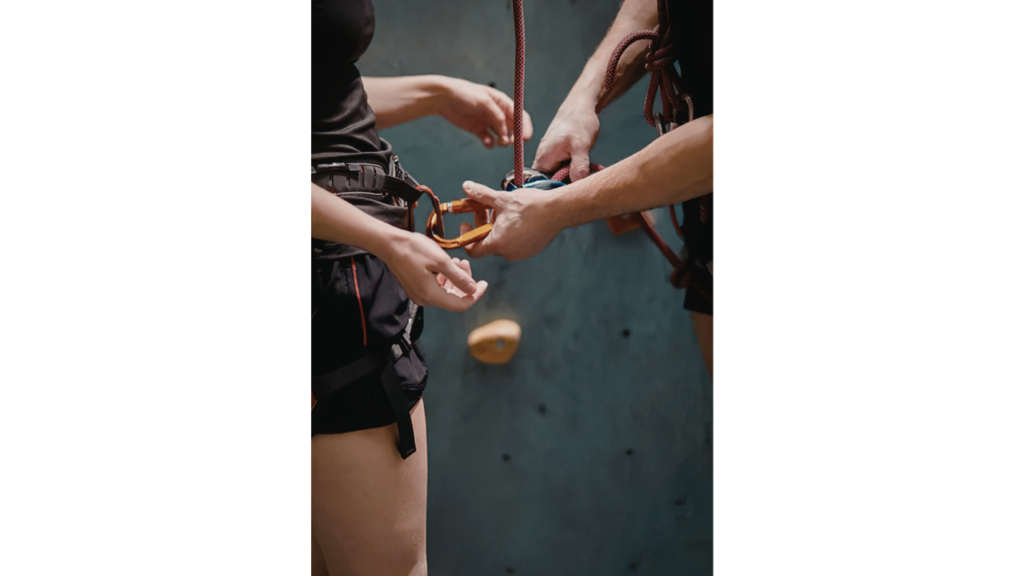
- Search for your nearest indoor climbing wall. Many now have para-climbing sessions or staff trained to help people with health conditions. Be direct and don’t be afraid to ask for help!
- In the UK, Natalia is running sessions in Bradford and working to expand to Leeds
- In Spain, Jordi and Rebecca are building a climbing community for people with Parkinson’s
Natalia’s big goal is for climbing to become a recommended intervention for Parkinson’s, like boxing already is, with the data to back it up.
The Bottom Line
“When you get lemons, make lemonade.”
Climbing and Parkinson’s is an amazing combination. It challenges your body and your brain at the same time. It builds a community. It restores a sense of independence and achievement. And, crucially, there is a level for everyone.
If you’d like to learn more, listen to the full episode of Shaking It Up with Parkinson’s